
If you share your home with a dog, a cat, or both, you already know the struggle. You want furniture that survives real life, which means fur embedded in cushions, the occasional accident, and a house that gets genuinely warm in summer. But you also don't want your living room to look like a waiting area at a vet clinic. Choosing the right pet-friendly upholstery fabric for summer furniture means balancing durability, breathability, cleanability, and aesthetics all at once. This guide walks you through exactly how to do that, step by step.
Step-by-Step Instructions for Choosing the Right Pet-Friendly Summer Upholstery Fabric
- Start with your actual threat assessment. Before you look at a single swatch, sit down and think honestly about what your furniture faces. Does your dog shed heavily? Do you have a cat who treats armrests like a scratching post? Do accidents happen occasionally or regularly? Is your living room warm and stuffy in summer, or do you run the AC constantly? Your answers will narrow your fabric choices fast. A light shedder in an air-conditioned home has very different needs than a three-dog household in a sun-drenched living room.
- Learn the one number that actually predicts durability. That number is the double rub count. A double rub simulates one back-and-forth motion of someone sitting on fabric. It's a standard industry test, and it tells you how much friction a fabric can take before it starts to break down. For a pet household, you want a minimum of 30,000 double rubs. Fabrics rated at 50,000 or higher are considered heavy-duty and genuinely hold up to claws, frequent sitting, and repeated cleaning. If a fabric listing doesn't include this number, ask before you buy.
- Prioritize solution-dyed or performance fibers for any fabric that touches pets. Solution-dyed acrylic is one of the most practical fibers available for pet households. The color is locked into the fiber during manufacturing, not applied to the surface, which means spills and stains don't penetrate the way they do with conventionally dyed fabrics. It also resists UV fading, which matters a lot in summer when sunlight pours through windows onto your sofa. Performance fabrics made with solution-dyed fibers typically achieve double rub counts of 50,000 or higher and can be cleaned with mild bleach solutions without damaging the color.
- Match your fabric type to your specific pet problem. Not every pet-friendly fabric works the same way for every situation. Here's how the main options break down for summer use:
- Faux leather and vinyl: Both are wipe-clean and completely fur-resistant. Fur sits on the surface and brushes right off. The downside in summer is heat retention. Vinyl especially can feel uncomfortably warm against bare skin. If you love the look, use it on accent chairs or ottomans rather than your main sofa, or choose a furniture placement away from direct sun.
- Chenille: Honestly, chenille is criminally underrated in the pet conversation. It's soft, it looks genuinely luxurious, and many chenille fabrics carry high double rub counts. The tightly woven pile actually holds up better than you'd expect. It's not the easiest for heavy shedders since fur can work into the pile, but a lint roller handles it well. In summer, it's breathable enough to be comfortable.
- Canvas and cotton duck: Tightly woven cotton fabrics are breathable, washable, and affordable. They don't trap heat the way synthetic blends can. A 100% cotton canvas or duck with a stain-resistant finish is a solid budget-friendly summer choice. Double rub counts vary, so check the spec sheet before buying.
- Outdoor-grade woven fabrics: These are technically made for patio furniture, but there's no rule against using them indoors. They're engineered for UV resistance, moisture, and heavy use. They breathe reasonably well, and many are rated above 50,000 double rubs. They can look a little casual, but paired with the right room, they work beautifully.
- Velvet: Velvet gets a bad rap in pet households, and it's not entirely deserved. A high-quality performance velvet, especially one made from solution-dyed polyester or acrylic, is actually fairly easy to clean. The challenge is pet hair, which clings to the pile. If you love velvet and you have pets, go for a darker color or a patterned velvet that makes fur less visible between cleanings.
- Microfiber: Tightly woven microfiber is one of the most practical pet fabric choices available. It resists liquid penetration, it's easy to wipe clean, and fur doesn't embed the way it does in looser weaves. It's not the most exciting fabric visually, but modern microfiber comes in a much wider range of colors and textures than it used to.
- Think carefully about texture and fur visibility. Light-colored fabrics show dark fur. Dark fabrics show light fur. This is just physics, and no fabric finish changes it. The practical solution is to choose a fabric color that's close to your pet's coat color, or to choose a multi-colored or patterned fabric that breaks up the visual. A heathered grey woven fabric, for example, hides a lot. A solid cream linen hides nothing.
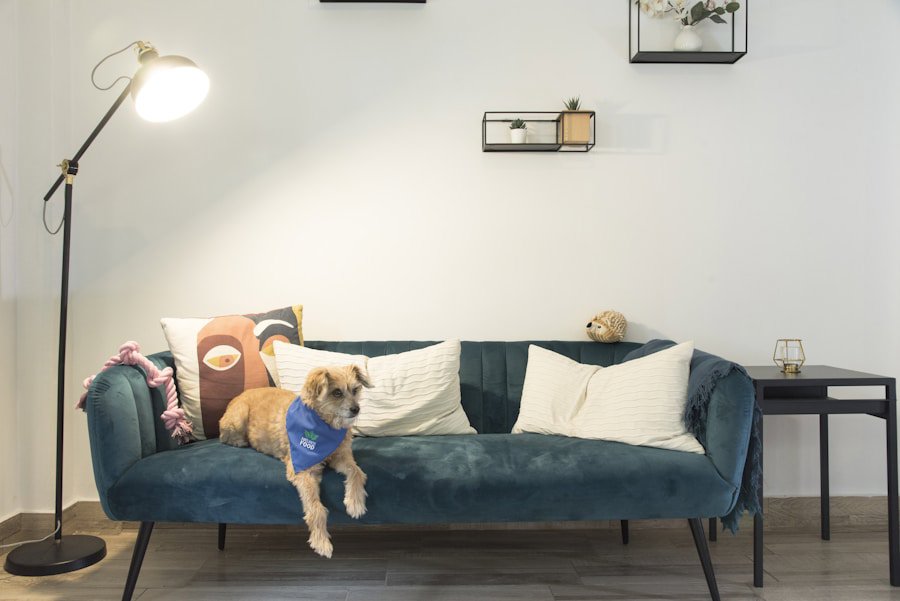
Photo by Real Natures Food on Unsplash
- Factor in summer breathability as a real comfort consideration. In summer, your furniture's breathability matters more than most people account for. Tightly woven synthetic fabrics and vinyl can trap heat quickly when it's warm. Natural fibers like linen and cotton breathe well but aren't always the most durable choice for pets. The sweet spot is a performance fabric that blends synthetic durability with a more open weave. Outdoor-grade acrylics and performance blends often hit this balance well. If your living room gets afternoon sun, put breathability near the top of your list.
- Check the cleaning instructions before you fall in love with a fabric. Every fabric has a cleaning code, and it matters. The codes break down like this: W means you can use water-based cleaners. S means solvent-based only. WS means either works. X means vacuuming only, no liquid. For a pet household, you want W or WS at minimum. An S or X code in a home with pets and kids is a recipe for a ruined sofa. If a fabric you love carries an S code, ask the retailer whether there's a similar fabric in a more cleanable finish.
- Consider a performance fabric treatment or pre-treated fabric. Many upholstery fabrics are now available with built-in stain and moisture repellency. These finishes work by creating a barrier on the fiber surface that causes liquids to bead and roll off rather than penetrate. They're not permanent, and repeated washing will reduce their effectiveness over time, but they add a meaningful layer of protection. If a fabric you're considering doesn't come pre-treated, ask about applying a topical fabric protector after installation.
- Think about color and pattern strategically for a real room, not a magazine photo. Pet-friendly doesn't have to mean beige or brown, though both are genuinely practical choices. A deep teal woven, a warm terracotta chenille, a charcoal grey microfiber, a multi-colored stripe that incorporates your pet's fur color. All of these can work beautifully in a living room and be genuinely livable. Current summer 2025 trends lean toward earthy warm tones and textured naturals, which happen to be excellent for hiding the evidence of daily pet life. Warm browns, sandy neutrals, and olive greens are all having a moment right now, and they're practical too.
- Order samples before you commit. This is the step most people skip and most people regret skipping. Fabric looks different on a screen than it does in your room, in your light, next to your floors and walls. Order a physical sample, live with it for a few days, and test it. Rub it with a damp cloth. Press pet hair into it and see how easily it comes out. Hold it near a sunny window and see how it feels in the heat. A sample costs almost nothing compared to a full reupholstery project or a furniture purchase.
What Is the Most Durable Upholstery Fabric for Pet Owners?
For most pet households, a solution-dyed performance fabric rated at 50,000 or more double rubs is the most durable choice. These fabrics combine high abrasion resistance with color stability and easy cleaning. Tight weaves in microfiber or outdoor-grade acrylic are especially practical because fur doesn't embed deeply and liquids don't penetrate quickly. If you want a fabric that genuinely holds up to claws, spills, and repeated cleaning without fading or pilling, look for solution-dyed acrylic or a high-density polyester performance blend with a verified double rub count on the label.
The Martindale abrasion test is another rating you may see, especially on European-made fabrics. It works similarly to the double rub test but uses a different circular motion. A Martindale rating of 25,000 cycles is considered suitable for heavy domestic use. Anything rated 40,000 cycles or above is appropriate for the kind of wear a pet household delivers. Both ratings tell you the same fundamental thing: how long the fabric will last under real friction before it starts to show wear.
Which Fabrics Should You Actually Avoid for Pets in Summer?
Loosely woven fabrics are the first ones to skip. Open weaves, chunky knits, and loosely constructed linens give claws something to catch, and pet hair works its way into the gaps and becomes nearly impossible to remove. They're also not the most durable by double rub count.
Silk and delicate blended fabrics are a hard no for pet households. They're simply not engineered for the kind of friction, moisture, and claw contact that pets deliver daily. The same goes for fabrics with looped pile construction, like some bouclés, where cat claws in particular can snag and pull threads. A high-quality boucle made with tightly bound loops is a different story, but a loosely constructed one will look destroyed within months.
Pure linen without any performance treatment is also worth skipping if accidents are a real possibility. Linen is beautiful and breathable, which makes it tempting in summer, but it absorbs liquid quickly and can be difficult to clean thoroughly without leaving a mark. A linen-blend performance fabric with a moisture barrier finish is a smarter compromise if you love the look.
Quick Tips Before You Buy
- Double rub count of 30,000 minimum, 50,000 or higher for heavy pet households.
- Look for a W or WS cleaning code on every fabric you consider.
- Solution-dyed fibers resist both stains and UV fading, which matters in sunny summer rooms.
- Match your fabric color to your pet's coat color as closely as you can tolerate aesthetically.
- Always order a physical sample and test it before committing to a full project.
- Avoid loosely woven fabrics, looped pile constructions, and delicate natural fibers without performance treatment.
- If breathability is a priority, outdoor-grade acrylics and woven performance blends are your best friends in summer.
Frequently Asked Questions
Q: What upholstery fabric is easiest to clean if you have pets?Faux leather, vinyl, and tightly woven microfiber are the easiest upholstery fabrics to clean in a pet household. Fur sits on the surface and wipes away easily, and liquid spills don't penetrate before you can blot them. Solution-dyed performance fabrics in woven constructions are a close second and offer more visual variety if you want something that doesn't look like a car seat.
Q: Is velvet a bad choice for homes with cats or dogs?Velvet isn't automatically a bad choice for pets, but it requires realistic expectations. Pet hair clings to velvet pile and needs frequent lint rolling. A performance velvet made with solution-dyed polyester or acrylic is more resistant to staining and easier to clean than traditional silk or rayon velvet. If you commit to regular maintenance, a quality performance velvet can work in a pet household.
Q: What does double rub count mean and how high should it be for pets?A double rub count measures how many times a fabric can be rubbed back and forth before it shows signs of wear or breakdown, simulating the friction of regular use. For a household with pets, look for a minimum double rub count of 30,000. Heavy pet households with large dogs or multiple animals should target 50,000 double rubs or higher for the best long-term durability.