
Your furniture has been through some things. Maybe the armrests are shiny and flat where everyone leans. Maybe the seat cushions have faded unevenly, or there's a spot where a pet claimed territory years ago and the fabric never quite recovered. Before you start shopping for spring upholstery fabrics, it pays to actually look at your furniture, understand what the wear is telling you, and match your fabric choice to the reality of what you're working with. This guide walks you through exactly that process, step by step, so you end up with something beautiful that actually lasts.
Step-by-Step Instructions
- Audit your furniture's wear patterns before you touch a swatch. Walk through your space and look at every upholstered piece with fresh eyes. Where is the fabric thinning? Where has color faded? Are the cushions pilling, flattening, or splitting at the seams? Worn armrests and seat fronts tell you that abrasion resistance needs to be your top priority. Fading near windows tells you UV stability matters. Pilling on the seat tells you the original fabric had a low fiber twist, and you'll want to avoid the same mistake this time. Write it down. You're essentially diagnosing before you prescribe.
- Measure the actual damage to decide if you need full reupholstery or targeted fabric work. Full reupholstery is a significant investment. But a lot of furniture just needs help in specific areas, like a tight seat cover replacement, new arm caps, or a set of slipcover panels. If the frame is solid and the foam isn't completely collapsed, targeted re-covering with fresh fabric is absolutely a viable path. Run your hand under the seat cushions and press on the frame corners. If it feels sturdy, you're likely a good candidate for a fabric refresh rather than a full job.
- Match your fabric weight to the furniture's workload. Not all pieces age the same way because not all pieces get used the same way. A formal dining chair that sees weekend use needs different fabric than a sectional that holds three kids, a dog, and a rotation of takeout containers. For high-traffic seating, look for fabrics with a double rub count of at least 30,000. Double rub count is the industry measure of how many back-and-forth rubs a fabric can handle before it shows wear. A standard sofa in a busy household should have a minimum of 15,000 double rubs; 30,000 or higher is genuinely better. Chenille, for example, often clocks in between 30,000 and 100,000 double rubs depending on the weave. Honestly, chenille is criminally underrated for exactly this reason.
- Choose a color strategy that accounts for existing fading or patina. If your furniture has visible fading but the bones are good, fighting the patina is usually the wrong move. Going with a tone that acknowledges the existing warmth, rather than clashing with it, makes the whole piece look intentional. For spring, warm neutrals like cream, beige, and sand work beautifully because they're light without being stark, and they complement the golden undertones that sun-faded wood and foam tend to develop over time. If you want to go bold, softer blues and greens read as fresh and seasonal without demanding perfect neutral surroundings. Avoid very dark solids on furniture that's already showing light wear patches. Those patches will read as stains even when they're just structural.
- Identify the fiber type that fits your specific wear problem. Different wear patterns point to different fiber solutions. Here's a quick read: thinning and abrasion on seat edges means you need a tightly woven fiber with high tensile strength, linen blends and solution-dyed acrylics perform well here. Fading near windows means you need a solution-dyed fiber, one where the color is locked into the fiber itself rather than applied on top, because surface dyes fade faster. Pilling means you want a smooth, high-twist yarn rather than a looped or cut pile. If pet scratching is the main issue, microfiber and tightly woven vinyl or faux leather tend to resist claw damage better than any natural fiber. Solution-dyed acrylic fabrics retain color up to five times longer than conventionally dyed fabrics in UV-exposed conditions, which matters a lot for pieces near south or west-facing windows.
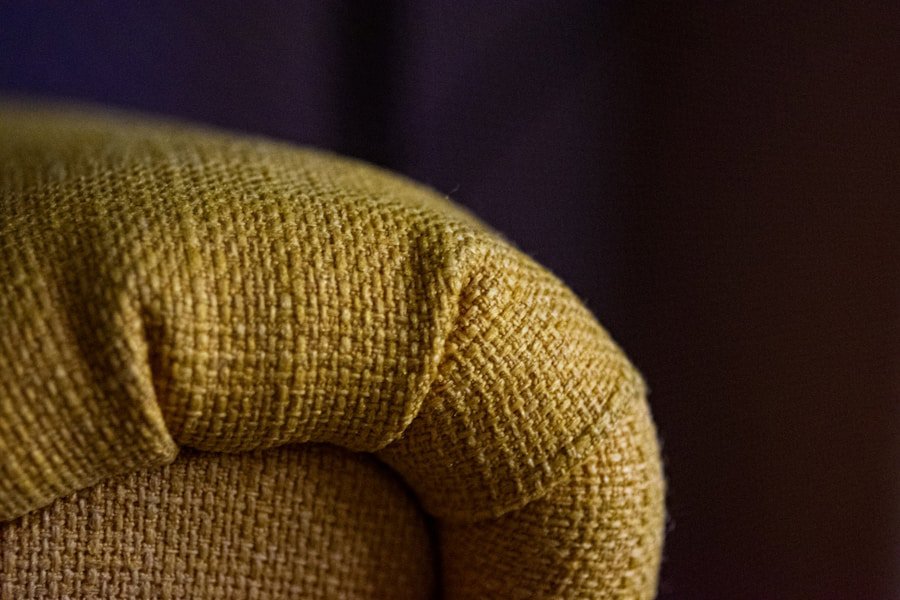
Photo by Marc Rentschler on Unsplash
- Consider texture as a practical tool, not just a design choice. Texture does real work in covering imperfect surfaces. A flat, solid-colored fabric will show every uneven area of a recovered cushion. A woven texture, a boucle, or a jacquard pattern distributes visual noise and makes small imperfections invisible. If your furniture has some minor reshaping or foam replacement in certain areas but not others, a textured fabric is your best friend. Boucle is having a strong moment in spring home decor right now, and it earns its popularity because the looped surface reads as relaxed and modern while hiding a lot of surface variation underneath. Just avoid boucle if you have cats. The loops are genuinely irresistible to them.
- Test your fabric's cleanability against your actual household. Before you commit, be honest about what this furniture faces. Water-based stains, oil-based stains, pet accidents, and crayon are all different cleaning problems, and not every fabric handles all of them equally. Look for fabrics rated with a W (water-cleanable), S (solvent-cleanable), or W/S (both) cleaning code. For families with kids or pets, W or W/S rated fabrics are strongly preferable. Performance fabrics that are specifically solution-dyed and treated with a topical stain protector give you the widest margin. Crypton-finished fabrics, for example, have a moisture barrier woven into the fiber structure, not just sprayed on top, which makes them genuinely more durable under repeated cleaning.
- Pull your spring palette together around one fabric anchor piece. Spring refreshes work best when you're not trying to change everything at once. Pick one fabric, usually for your largest or most visible piece, and let that anchor your choices. Right now, soft sage greens, warm whites, dusty pinks, and textured neutrals are the strongest spring upholstery directions. Pair a textured neutral like a woven beige or cream with a single color accent on a smaller piece, like a dining chair seat or an ottoman, and you'll get a seasonal refresh that feels curated rather than chaotic. Plus, buying fabric for one statement piece is a lot more budget-friendly than committing to a full room redo.
- Order samples before you buy yardage. This one sounds obvious but gets skipped constantly. Fabric looks different on a monitor than it does in your actual room, under your actual lighting, next to your actual floors. Order samples of your top two or three choices. Live with them for a day or two, ideally placing them on the actual piece of furniture you're recovering. Check them in morning light, afternoon light, and lamp light. The one that still looks good at 9pm on a Wednesday is usually the right call.
- Calculate your yardage with wear in mind, then add a buffer. Standard yardage calculators assume clean, flat cutting. If your furniture has unusual angles, curved arms, or you're pattern-matching a print, add at least 15 to 20 percent to your calculated yardage. If you're working around worn areas that you need to cut around or reinforce with interfacing, add a bit more. Buying short is a real problem because dye lots change, and even the same fabric ordered two months apart can be a slightly different shade. Buy enough the first time.
Photo by Sophia Kunkel on Unsplash
What Fabric Works Best on Furniture That Already Shows Heavy Wear?
For furniture showing heavy wear, tightly woven synthetic blends or performance fabrics with a double rub count above 30,000 are the most practical choice. They resist further abrasion, clean easily, and don't amplify the visual imperfections of an aged piece.
Specifically, chenille, microfiber, and performance woven fabrics give you the best combination of durability and visual forgiveness. Chenille's dense pile masks surface irregularities. Microfiber's tight weave resists staining and scratching. Woven fabrics, particularly those with a multi-color or tonal pattern, hide seam variations and slight differences in cushion fullness that become visible when you re-cover rather than fully reupholster. The Martindale abrasion test, common in European fabric grading, is a useful parallel to double rub count. A Martindale rating of 20,000 or higher is considered suitable for general domestic use; 40,000 or higher is appropriate for heavy-use domestic seating.
Which Spring Colors Hide Wear Best on Aging Furniture?
Mid-tone colors and multi-tonal patterns hide wear best on aging furniture, because they reduce contrast between clean areas and areas that develop slight soiling or compression over time.
For spring specifically, warm mid-tones work harder than you'd expect. A soft sage green, a warm sand or beige, or a dusty blush pink all sit in a range where minor staining doesn't scream at you and fading reads more as a lived-in finish than damage. Very light colors like bright white and very dark colors like black are both unforgiving on imperfect surfaces. White shows every shadow and seam. Black shows every dust particle, pet hair, and compression mark. If you love both, use them as accent fabric on lower-traffic pieces or pair them with a stain-protective finish. The sweet spot for a real-world spring refresh is a light-to-mid tone with some texture built in, which gives you warmth and visual camouflage at the same time.
Quick Tips for Getting This Right
- If you're covering over a foam cushion that's started to break down, replace the foam first. New fabric over bad foam looks worse than old fabric over bad foam, because the new fabric is tighter and shows every lump.
- Patterned fabrics like florals, stripes, and jacquards are more forgiving of slight mis-cuts and reupholstery seams than solid fabrics. They're a good call for a first DIY project.
- If your piece has sentimental value but the fabric is genuinely beyond recovery, consider recovering just the seat cushions in a new spring fabric and leaving the frame in its existing state. The contrast of old patina with fresh fabric is actually a very current design direction.
- Always check the fabric width before ordering. Most upholstery fabrics run 54 inches wide, but some decorative and designer prints run narrower. This changes your yardage math significantly.
- Spring is a good time to re-evaluate whether your existing furniture arrangement is adding to your wear patterns. A sofa sitting in direct afternoon sun will fade any fabric faster than one placed away from the window. Sometimes the fix is moving the furniture, not replacing the fabric.
Frequently Asked Questions
Q: How do I know if my furniture is worth reupholstering or if I should just replace it?If the frame is solid wood and structurally sound, the piece is worth recovering. Check by pressing firmly on the corners and arms. If nothing flexes or creaks, the bones are good. Replacing foam and fabric is almost always cheaper than buying new furniture of equivalent quality, and it lets you choose exactly the fabric that fits your home.
Q: What is a good double rub count for upholstery fabric in a home with kids and pets?For homes with kids and pets, look for a double rub count of at least 30,000. This means the fabric can withstand the equivalent of 30,000 back-and-forth rubs before showing measurable wear. Many performance fabrics designed for family use reach 50,000 to 100,000 double rubs, which translates to genuinely years of heavy daily use.
Q: Can I use drapery fabric for upholstery to save money?Generally, no. Drapery fabric is woven for drape and visual effect, not for the friction and pressure that upholstery faces every day. It typically has a much lower double rub count, often under 10,000, and will wear out quickly on seating. Using proper upholstery-weight fabric protects your investment in both labor and the furniture itself.