
Summer is great for a lot of things. It is not great for your furniture. Between pets shedding their winter coats, kids coming in from the yard with questionable substances on their hands, and the general chaos of a house that's actually being lived in, your upholstery takes a beating from June through August. This guide is here to help you choose upholstery fabrics that withstand summer pet accidents, shed hair, and outdoor play without forcing you to choose between durability and a couch you actually want to sit on. You can have both. Here's how to get there.
Step-by-Step Instructions: How to Choose the Right Upholstery Fabric for Summer
- Start with your actual lifestyle, not your Pinterest board. Before you think about color or texture, get honest about how your furniture is used. Do you have a dog who claims the sofa as their personal napping territory? A toddler with a juice box and zero regrets? The right fabric starts with an accurate picture of what it's up against. Make a short mental list: pets, yes or no. Kids, what ages. Outdoor access, how often. That list becomes your filter for everything that follows.
- Learn what double rub count means, because it actually matters. Double rub count measures how many times a fabric can be rubbed back and forth before it shows wear. One "double rub" is one back-and-forth motion. A fabric rated at 15,000 double rubs is considered suitable for light residential use. For households with kids and pets, look for fabrics rated at 30,000 double rubs or higher. Heavy-duty performance fabrics often reach 100,000 or more. This number is one of the most reliable ways to compare durability across different fabric types, and it's worth asking about before you buy.
- Understand which fabric types are built for this kind of life. Not all fabrics are created equal when summer arrives with its full cast of chaos. Here's how the main players stack up for pet-heavy, kid-friendly households.
- Faux leather and vinyl are genuinely hard to beat for pet accidents and spills. Neither fabric absorbs liquid, so a quick wipe usually handles the mess. Faux leather has a more premium look and feel, while vinyl tends to be the more budget-friendly option. Both resist pet hair sticking, which is a real daily win. Shop faux leather upholstery fabric and vinyl upholstery fabric at Famcor.
- Chenille is criminally underrated for families. Honestly. It's soft, it looks expensive, and tightly woven chenille holds up well to everyday use. It's not the best choice if your pet has accidents directly on it, but for hair and general wear, it performs well above expectations. Explore chenille upholstery fabric options.
- Outdoor-rated fabrics and solution-dyed acrylics are worth considering even for indoor furniture in summer. Solution-dyed acrylic means the color is baked into the fiber during production, not applied to the surface. This makes the fabric highly resistant to fading, staining, and moisture. Many performance fabrics used for both indoor and outdoor furniture use this technology. They're easy to clean, often with just soap and water.
- Woven and jacquard fabrics can work well if the weave is tight and the fiber content is synthetic or blended. Looser weaves snag more easily with pet claws and trap hair in the texture. Tightly woven options in polyester or a poly blend are a much smarter call. Browse woven upholstery fabric and jacquard upholstery fabric.
- Velvet gets a bad rap, but microfiber velvet specifically is one of the easiest fabrics to clean. It resists liquid if you catch it quickly, and pet hair can often be removed with a rubber glove or lint roller. Standard velvet, especially in natural fibers like silk, is a different story. Stick to synthetic velvet blends for busy households. Shop velvet upholstery fabric here.
- Look for performance finishes and fiber types, not just fabric names. The fiber content listed on a fabric swatch tells you a lot. Polyester and polypropylene fibers are inherently moisture-resistant and easy to clean. Fabrics with stain-resistant finishes (sometimes labeled as treated or performance fabrics) add another layer of protection. For summer specifically, fabrics that resist humidity and mildew are worth the slight upcharge. Linen and cotton are beautiful but they absorb moisture readily, which makes them less ideal for a summer household with pets and wet kids tracking in from outside.
- Think about hair and shedding specifically, not just stain resistance. Pet hair is its own category of problem. Fabrics with a tight, smooth surface, such as faux leather, vinyl, and microfiber, make hair easy to wipe or vacuum away. Heavily textured fabrics like bouclé and some chenilles can trap hair deep in the weave, making removal a project. If you have a high-shedding dog or cat, smooth or semi-smooth surfaces will save you a significant amount of weekly effort. If you love the look of a textured fabric, consider using it on lower-traffic pieces like accent chairs rather than the main sofa.
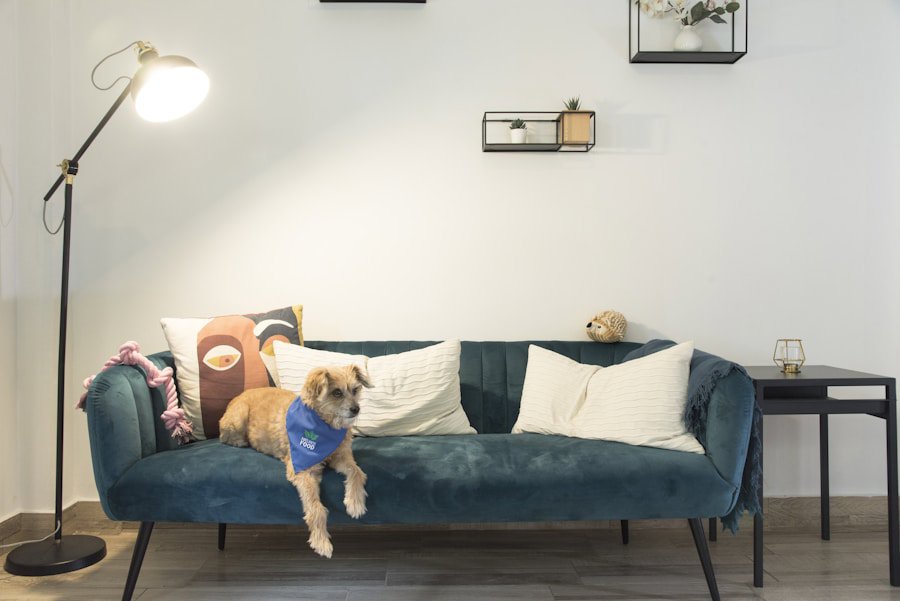
Photo by Real Natures Food on Unsplash
- Match your color choice to your household's reality. This is not about settling. It's about being strategic. Mid-tones, heathers, and patterns are your friends in a busy house. A solid beige chenille shows every muddy paw print immediately. The same style in a warm taupe or a multi-toned woven? Much more forgiving. Darker solids like navy or charcoal can show pet hair from light-colored dogs and cats. If you have pets, consider the color of their coat when picking a fabric color. It sounds obvious, but it's easy to forget in the middle of a fabric sample pile. Browse multi-colored upholstery fabrics, brown, and grey upholstery fabrics for practical, good-looking options.
- Consider how you'll actually clean it, not just how it's rated. A fabric can be technically stain-resistant but still require a specific cleaning code or solvent-based cleaner. Check the cleaning code before you buy. Most fabrics use one of four codes: W (water-based cleaners only), S (solvent-based cleaners only), W-S (either), or X (vacuum only, no liquid). For a summer household, W or W-S codes are the most practical. You want to be able to grab a damp cloth when the dog has an accident, not search for a specialty cleaner at 10pm.
- Test before you commit, even with online orders. Order samples. This is not optional when you're reupholstering furniture that needs to survive real life. Feel the weight of the fabric. Run your nails lightly over it. Press a damp cloth to it and see how quickly it absorbs or repels. Hold it up to light and look at the weave density. A fabric that feels thin or shifts when you pull it lightly at the corners is probably not going to last two summers in a busy home. Most fabric retailers, including Famcor, offer sample swatches so you can test before committing to yardage.
- Balance durability with comfort because you actually have to live on this thing. High-performance fabrics have come a very long way. There is no reason in 2024 to choose between a couch that's easy to clean and one that's comfortable to sit on for two hours during a Sunday movie. Microfiber velvet is soft and practical. Performance chenille is cozy and durable. Faux leather has options that feel genuinely supple rather than plasticky. The old assumption that durable equals stiff and ugly simply doesn't hold up anymore. Shop the modern textures collection for fabrics that prove this point.
- Buy a little more yardage than you think you need. If you're reupholstering, add at least 10 to 15 percent to your estimated yardage. Pattern matching, cutting errors, and future repairs all eat into your fabric supply. For households with pets, having a remnant piece of the same fabric stored away means you can repair a section of upholstery down the road without trying to match a discontinued print. It's a small insurance policy that costs very little upfront.
What Is the Most Durable Upholstery Fabric for Pets and Kids?
Faux leather and high-performance polyester fabrics rated at 50,000 double rubs or higher are the most durable upholstery choices for households with pets and children. They resist moisture, clean easily, and hold up to repeated use without breaking down quickly. For families who want a softer feel, tightly woven synthetic chenille or microfiber velvet rated above 30,000 double rubs offer a strong balance of durability and comfort. The key is prioritizing synthetic fiber content and a tight weave structure over purely aesthetic qualities when durability is the primary need.
Fun fact: the Martindale abrasion test, used widely in the UK and Europe, measures fabric durability similarly to the double rub count. A fabric rated at 20,000 Martindale cycles is considered suitable for general domestic use, while 40,000 and above is classified as heavy duty. Many performance upholstery fabrics sold in the US are tested using both methods, and fabrics meeting heavy-duty Martindale thresholds consistently outperform lighter-weight options in real-world pet and kid traffic.
Which Upholstery Fabrics Are Easiest to Clean After Pet Accidents?
Faux leather, vinyl, and solution-dyed acrylic fabrics are the easiest upholstery fabrics to clean after pet accidents because they do not absorb liquid into the fiber. A damp cloth or mild soap-and-water solution handles most messes without leaving a lasting stain or odor. These fabrics also tend to carry a W or W-S cleaning code, meaning water-based cleaners are safe to use, which makes emergency cleanup fast and stress-free.
Microfiber fabrics, including microfiber velvet, are also highly cleanable when treated promptly. The extremely fine fiber structure of microfiber creates a surface that liquid beads on rather than immediately absorbing. Blotting (not rubbing) the spot quickly with a clean cloth removes most liquid before it sets. For urine specifically, an enzyme-based cleaner applied after the initial blot is the most effective follow-up treatment on any fabric type, because enzymes break down the proteins causing the odor rather than just masking them.
Quick Tips for Summer Upholstery Success
- Keep a small bottle of enzyme-based cleaner and a clean microfiber cloth near your main seating area during summer. Fast response beats the best fabric in a close contest.
- Use washable slipcovers on frequently used cushions if you want a more decorative fabric on the frame. Layer your protection strategy.
- Rotate cushions regularly. Uneven wear is one of the main reasons upholstery looks tired before it's actually worn out.
- Vacuum upholstery weekly during high-shedding seasons. Pet hair ground into fabric weave accelerates wear, especially on textured surfaces.
- Keep pets' nails trimmed. This is not a fabric tip exactly, but it extends the life of any upholstery more than any finish or coating will.
- If you're drawn to linen or cotton for the look, consider a linen-blend with polyester content. You get much of the aesthetic with significantly more practical performance.
Frequently Asked Questions
Q: What upholstery fabric is best for a couch if you have dogs?Faux leather and tightly woven microfiber or polyester fabrics are the best upholstery choices for dog owners. They resist pet hair sticking to the surface, clean up easily after accidents, and hold up to the kind of daily friction that dogs bring to furniture. Look for fabrics with a double rub count of at least 30,000 and a W or W-S cleaning code for the most practical everyday performance.
Q: Does velvet work with pets?Synthetic microfiber velvet can work well with pets. It resists liquid if you blot spills quickly, and pet hair removes more easily from microfiber velvet than from many textured fabrics. Natural velvet in silk or cotton is not a practical choice for pet households because it absorbs moisture and is difficult to clean without professional help. Always check fiber content before buying velvet for a pet-friendly space.
Q: How do I know if an upholstery fabric is durable enough before I buy it?Check the double rub count listed on the fabric specification. For households with pets and children, look for a minimum of 30,000 double rubs, with 50,000 or higher being ideal for heavy use. Also check the cleaning code to confirm water-based cleaners are safe to use. Ordering a fabric sample before purchasing full yardage lets you test the weight, weave density, and surface feel before committing to a full project.